Stone & Antiquity
The Inscriptions of Jabal Ikmah
A canyon that kept the words of a kingdom.
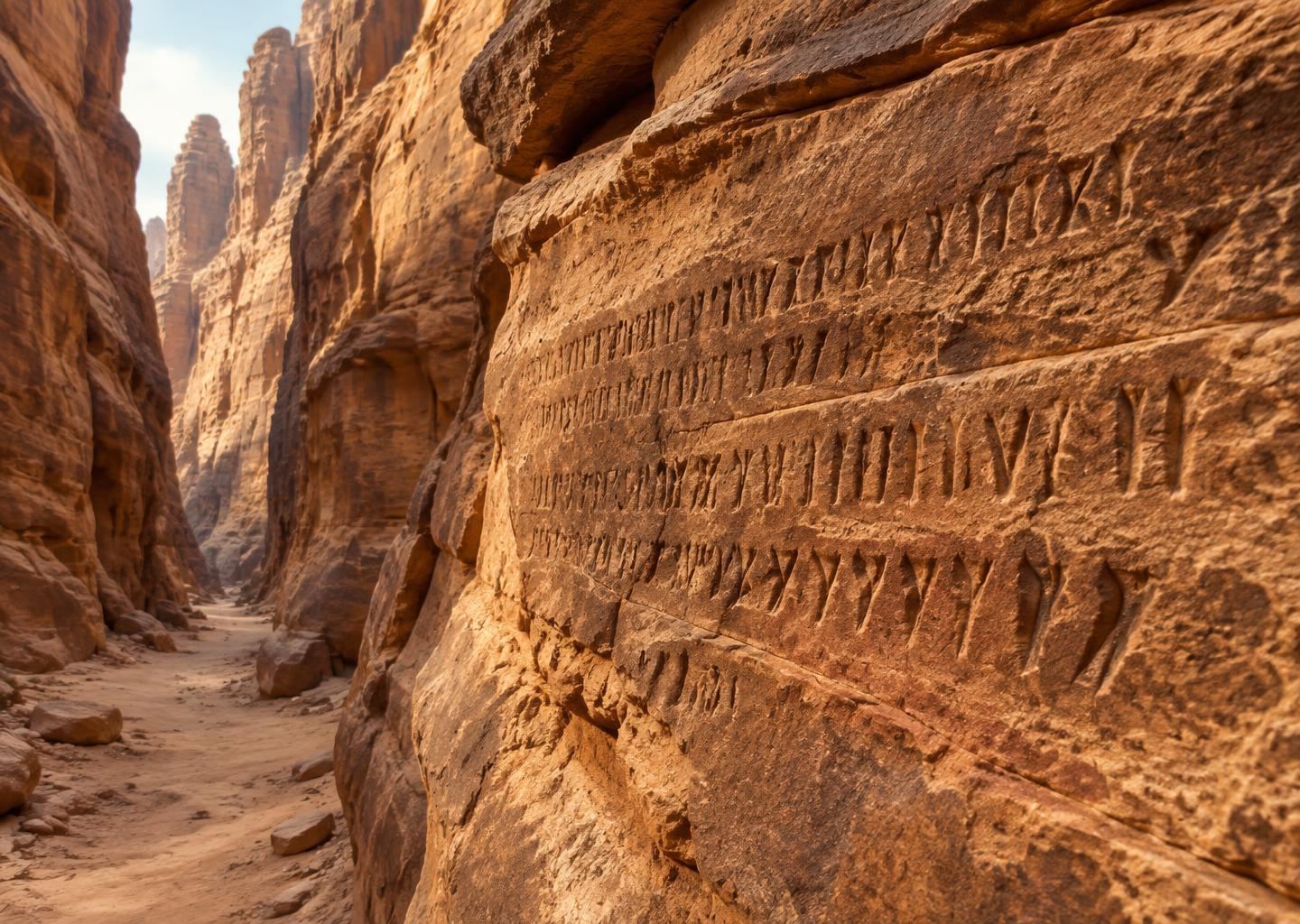
Walk into the narrow canyon of Jabal Ikmah and the walls begin to speak. Letters cut into the stone climb above you — names, dedications, prayers, and records left by the people of Dadan and Lihyan.
Most are written in Dadanitic, one of the ancient North Arabian scripts. Scholars read them to understand the language, beliefs and social life of the oasis kingdoms that once controlled this stretch of the incense route.
In 2023 the site was inscribed on UNESCO's Memory of the World Register — recognition that this is not only a landscape but a document. To visit is to stand inside a page of the peninsula's earliest written memory.
Al-Rawi says: read slowly. The stone has waited thousands of years; it can wait for you to look properly.
Inside the open-air library
What the stone remembers
Who wanted to be remembered?
Names and family relationships help researchers connect people with the society of the oasis. A name on stone can preserve a life otherwise absent from the historical record.
Dadanitic is an ancient North Arabian script. Exact readings belong to inscription-specific scholarly editions.
Field notes · open for depth
01Why scripts matter here
Jabal Ikmah preserves texts in several ancient North Arabian scripts, including Dadanitic. Scholars study them to trace how writing in Arabia developed toward the Arabic script.
02How to read a rock face
Look at raking light in early morning or late afternoon — shallow carving appears as shadow lines. Never touch or trace inscriptions; oils from skin damage the stone.
03A caution on translations
We do not reproduce or invent translations. Readings belong to published epigraphic research — follow the sources below.